

A place at the 2026 FIFA World Cup is up for grabs on Tuesday night as Czech Republic national football team host Denmark national football team in a high-stakes playoff final in Prague.
There is no margin for error now. After both sides navigated their semi-finals in very different fashion, the final hurdle will decide who books a ticket to the summer’s biggest stage, and who is left to wonder what might have been.
The Czech Republic arrive at this final having already lived through the kind of emotional playoff drama that can either sharpen a team or leave it emotionally drained.
Their semi-final win over the Republic of Ireland was anything but straightforward. Miroslav Koubek’s side twice had to come from behind, and for long stretches they looked vulnerable to the pace and directness of the visitors. Yet they also showed something important: resilience.
Patrik Schick pulled them level the first time, Ladislav Krejci rescued them again late on, and after a tense extra-time period, they eventually came through on penalties thanks in large part to Matej Kovar. It was not polished, but it was the sort of result that can give a team psychological momentum ahead of a winner-takes-all final.
Still, there are warning signs. The Czechs showed attacking spirit, but they also looked far from secure defensively, particularly when transitions opened up. Against Denmark, a more controlled, tactically mature opponent, those moments of looseness may be punished more ruthlessly.
Brian Riemer’s side were made to work in the first half against North Macedonia, but once the breakthrough arrived, they were ruthless. A 4-0 victory did more than simply book their place in the final, it also reinforced the sense that Denmark remain one of the most balanced and tournament-ready sides in Europe outside the continent’s absolute elite.
That balance is what makes them dangerous. Denmark do not always overwhelm opponents with sheer flair, but they are tactically disciplined, physically reliable, and capable of producing decisive quality in the final third when games open up.
Their group-stage qualification campaign was not perfect, particularly with the defeat to Scotland that ultimately denied them automatic progression, but they remain a side with enough experience and structural clarity to handle this type of occasion. This is also a team with recent World Cup pedigree. Denmark know what it takes to get there, and they will believe they have the tools to avoid falling at the final hurdle.
The Czech Republic, buoyed by home support and the momentum of surviving a chaotic semi-final, may look to play with intensity and directness. Expect them to target wide areas, look for crosses into Patrik Schick, and try to turn the game into an emotionally charged contest.
Denmark, by contrast, are likely to be more measured. They will want to control possession in phases, dictate tempo through midfield and avoid the sort of end-to-end game that could energise the home crowd. If they can quieten the atmosphere and force the Czechs to chase, the tactical balance may begin to tilt their way.
That makes the opening period especially important. If the hosts start fast and find an early breakthrough, the entire mood of the match changes. But if Denmark settle first, they may gradually begin to take control.
Set-pieces, defensive concentration and composure in key moments often decide playoff finals more than flowing football ever does. The Czech Republic showed last time out that they can stay alive in difficult moments, but Denmark may represent a sterner test precisely because they tend to make fewer emotional mistakes.
This is unlikely to be a match won purely by talent. It may instead come down to who handles pressure better. The Hard Tackle takes a look at how the teams could line up on the night and what tactics they might employ.
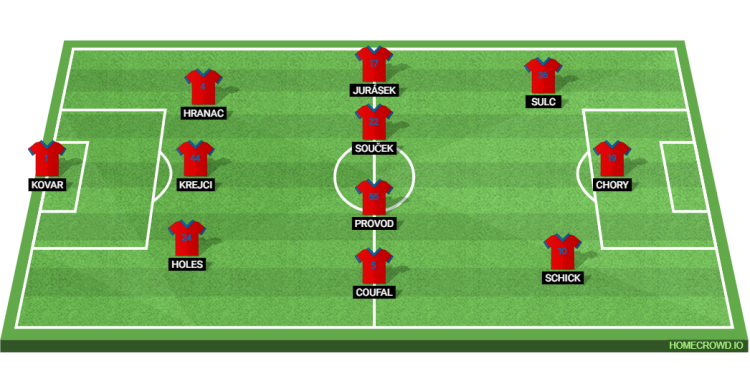
Miroslav Koubek is expected to keep faith with much of the side that came through a dramatic playoff semi-final against the Republic of Ireland, although there are still a few selection decisions to make ahead of this decisive clash. The most significant confirmed absentee remains Vaclav Cerny, who was unable to make the playoff squad due to injury, depriving the hosts of one of their more dangerous and direct wide attacking options.
There are no major suspension concerns reported for the Czech Republic heading into this final, which means Koubek should have the majority of his key players available. There is, however, room for slight adjustments, with Tomas Soucek, Michal Sadilek, Stepan Chaloupek, and Jan Kliment all pushing for stronger involvement after appearing from the bench in the semi-final.
The core of the side should still remain intact, particularly around important figures such as Ladislav Krejci at the back and Patrik Schick in attack, both of whom are expected to be central to the hosts’ hopes of reaching the World Cup. Tactically, the Czech Republic are expected to line up in a 3-4-3 formation, a system that should allow them to balance defensive structure with enough width and attacking support in advanced areas.
In goal, Matej Kovar is likely to continue between the posts after his heroics in the previous round, and he will once again be relied upon for both his shot-stopping and composure under pressure. The back three should consist of Tomas Holes, Ladislav Krejci, and Robin Hranac.
Holes is likely to offer defensive discipline and positional intelligence on the right side of the three, while Krejci should operate as the central leader and captain of the backline, bringing physical presence, aerial strength and leadership. Hranac is expected to complete the trio on the left side, where he can help cover space and support build-up play.
In midfield, Vladimir Coufal and David Jurasek are expected to operate as the wing-backs, providing the width that will be crucial to how the Czech Republic attack. Coufal should bring energy and experience down the right, while Jurasek is likely to offer forward thrust and crossing quality from the left.
Centrally, Lukas Provod and Tomas Soucek are expected to form the midfield pairing. Provod should help with progression and movement through midfield, while Soucek’s role will likely be pivotal in both defensive and attacking phases, given his ability to win duels, arrive late into the box and impose himself physically in key moments.
Further forward, the Czech Republic are expected to field Patrik Schick, Tomas Chory, and Pavel Sulc in the front three. Schick should be the primary attacking reference point and remains the side’s biggest goal threat, capable of deciding games with both his finishing and movement inside the area.
Chory is likely to provide physical presence and help occupy defenders, while Sulc should bring mobility, technical quality and the ability to drift into dangerous spaces around the final third. Overall, the hosts’ expected setup suggests a side that will try to use wing-backs aggressively, feed off home support, and create enough pressure around Denmark’s back line to make this a fiercely contested playoff final.
Probable Lineup (3-4-3): Kovar; Holes, Krejci, Hranac; Coufal, Provod, Soucek, Jurasek; Schick, Chory, Sulc
Brian Riemer heads into this playoff final with a number of important absentees still affecting the squad, particularly in defensive areas. Kasper Schmeichel, Andreas Christensen, Rasmus Kristensen, Patrick Dorgu, and Jannik Vestergaard all remain unavailable due to injury, which has forced Denmark to adjust both their defensive depth and overall balance.
In addition, Philip Billing, Yussuf Poulsen, and Andreas Skov Olsen were also not available for selection, further limiting Riemer’s options across midfield and attack. The good news for Denmark is that there are no fresh suspension issues for this final, and Joachim Andersen is once again available after serving his ban in the semi-final.
His return could be especially significant given the injury absences in central defence, and he is a strong candidate to come straight back into the starting XI. Despite those missing names, Denmark still arrive with plenty of confidence after their dominant 4-0 win over North Macedonia, and the overall feeling is that they still have enough quality and structure to remain strong favourites for qualification.
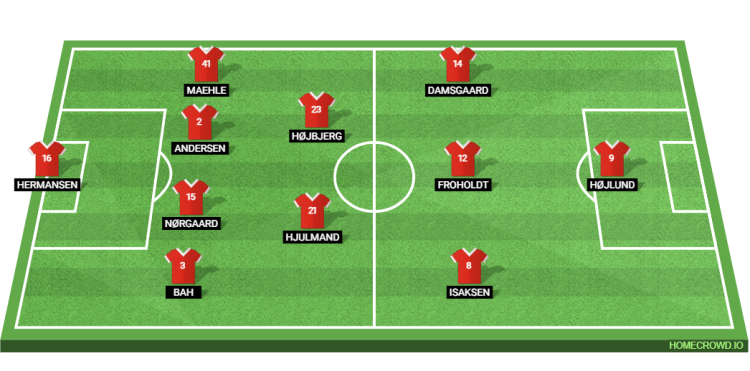
Tactically, Denmark are expected to line up in a 4-2-3-1 formation, a system that should allow them to remain compact, technically secure and dangerous in transition as well as in controlled possession. In goal, Mads Hermansen is likely to continue between the posts and will be expected to provide calmness and assurance in the absence of Schmeichel.
At right-back, Alexander Bah should offer energy and forward support, while Christian Norgaard may once again be asked to fill a deeper defensive role if needed alongside Joachim Andersen in central defence. Andersen’s return would bring experience, composure and much-needed stability to the back line. On the left side, Joakim Maehle is expected to start and should play an important role both defensively and in supporting attacks with his movement and delivery from wide areas.
In midfield, Denmark are likely to rely on the experienced pairing of Morten Hjulmand and Pierre-Emile Hojbjerg as the double pivot. Hjulmand should provide composure, ball recovery and control in deeper areas, while Hojbjerg will once again be crucial with his leadership, aggression and ability to keep Denmark organised in central zones. Together, they give the visitors a solid and disciplined platform from which to control the tempo and prevent the Czech Republic from turning the game into an open contest.
Further forward, Denmark are expected to field Gustav Isaksen on the right, Victor Froholdt in the central attacking midfield role, and Mikkel Damsgaard from the left, operating behind central striker Rasmus Hojlund. Isaksen enters the match in strong form after his brace in the semi-final and should provide pace, direct running and a real threat in one-on-one situations. Damsgaard offers creativity and intelligent movement from the opposite side, while Froholdt could be tasked with linking midfield and attack and finding pockets of space between the lines.
Up front, Hojlund remains Denmark’s main attacking reference point and will be expected to stretch the Czech back line, occupy defenders and convert the chances that come his way. Overall, Denmark’s likely setup suggests a side that should be well equipped to control key phases of the match, stay organised under pressure and punish any defensive lapses from the hosts.
Probable Lineup (4-2-3-1): Hermansen; Bah, Norgaard, Andersen, Maehle; Hjumland, Hojbjerg; Isaksen, Froholdt, Damsgaard; Hojlund
In matches of this magnitude, every team needs someone capable of delivering in decisive moments, and Schick remains the Czech Republic’s clearest difference-maker in the final third. He already showed his importance in the semi-final against the Republic of Ireland, stepping up to score when his side needed a response, and his overall presence gives the hosts a genuine edge whenever they manage to work the ball into dangerous areas.
What makes Schick such a key figure in this particular match-up is the nature of the contest itself. Denmark are likely to be organised, compact and difficult to break down, which means the Czech Republic may not create a huge volume of clear chances. In that kind of game, the value of a clinical striker increases enormously.
Schick does not always need multiple openings to make an impact, one well-delivered cross, one loose ball in the box, or one half-chance on the edge of the area can be enough. He is also likely to be central to how the Czech Republic try to attack.
With Vladimir Coufal and David Jurasek expected to provide width from wing-back, and with players like Pavel Sulc operating around him, Schick should receive service from wide and central areas. His movement, finishing and ability to occupy centre-backs could make him the focal point of much of the hosts’ attacking play.
Perhaps just as importantly, this is the kind of pressure-filled, emotionally charged occasion where experienced internationals tend to define the story. Schick has already proven across major tournaments and qualifiers that he can rise to those moments. If the Czech Republic are to overcome Denmark and return to the World Cup, there is a very strong chance Patrik Schick will be at the heart of it.
This has all the ingredients of a tight, high-pressure playoff final, and it would not be a surprise if it goes deep into the game, or even beyond 90 minutes. The Czech Republic will lean heavily on home support and momentum from their dramatic semi-final win.
They have shown resilience and character, and in a one-off game, that emotional edge can be significant. If they can start strongly and feed off the crowd in Prague, they have every chance of making this a difficult night for the visitors.
However, Denmark national football team look like the more controlled and balanced side. Their dominant 4-0 victory in the semi-final highlighted their ability to manage games and then accelerate when opportunities arise. With a strong midfield base and multiple attacking outlets, they appear better equipped to handle the tactical and psychological demands of a match of this magnitude.
The Czech Republic should make this competitive, and they may well push Denmark all the way, but the visitors’ composure and structure could ultimately prove decisive in the key moments.
