
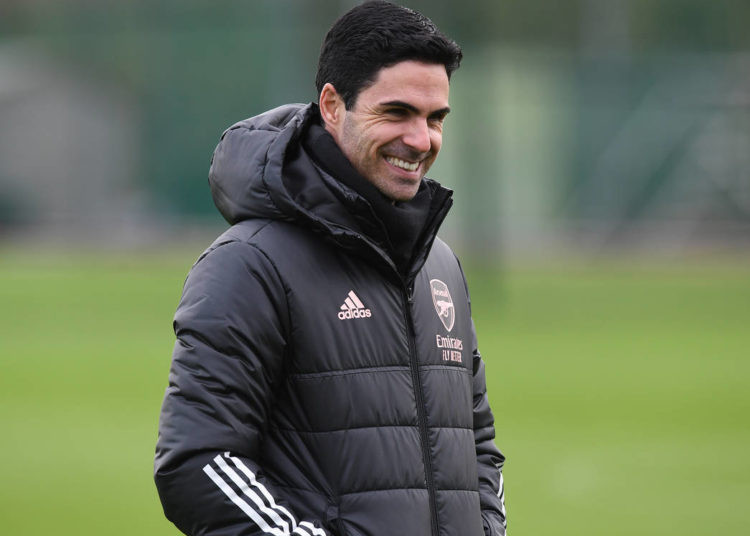
Mikel Arteta’s charges are no longer a hopeful contender; they are on the brink of becoming champions, a team that has fused tactical intelligence, technical precision, and emotional resilience into a title-winning formula. With one hand on the Premier League trophy and a place secured in the UEFA Champions League final, Arsenal have re-established themselves among Europe’s elite.
Yet, for all the brilliance of their current campaign, the conversation around Arsenal has already shifted from achievement to sustainability. Winning a league title is one challenge; building a dynasty that can dominate both domestically and in Europe is another entirely. And if this season has revealed anything, it is that even this exceptional Arsenal side has areas that require urgent refinement.
Arteta’s Arsenal have evolved into one of the most tactically coherent teams in Europe. Their positional play is deliberate, their pressing structure suffocating, and their ability to control matches, both with and without the ball, has been central to their success.
Declan Rice has elevated the midfield with his relentless energy and defensive coverage, while Martin Odegaard continues to orchestrate play with elegance and precision. Bukayo Saka remains the team’s talisman, consistently delivering in decisive moments, and the defensive unit, marshalled by William Saliba and Gabriel Magalhaes, has provided the platform for sustained dominance.
What sets Arsenal apart this season is their maturity. They no longer rely solely on momentum or moments of brilliance; instead, they impose themselves methodically, breaking opponents down with patience and intelligence. This has been particularly evident in Europe, where they have navigated high-pressure fixtures with composure well beyond their years.
However, beneath this near-flawless exterior lie subtle but significant shortcomings, areas that, if left unaddressed, could prevent Arsenal from establishing a prolonged era of dominance.
Despite their attacking efficiency, Arsenal’s forward line can at times feel predictable, particularly from wide areas. Much of their creative burden falls on Bukayo Saka, whose consistency on the right flank has been nothing short of elite. But on the opposite side, the same level of dynamism has been noticeably absent.
The arrival of Noni Madueke was intended to inject pace and unpredictability into Arsenal’s attack. Instead, his adaptation has been underwhelming. While flashes of individual quality have emerged, he has struggled to consistently influence games, often drifting in and out of matches without providing the decisive edge Arsenal require.
This imbalance has made Arsenal easier to defend against in certain scenarios. Opponents frequently overload Saka’s side, confident that the threat from the opposite flank is comparatively limited. For a team aspiring to dominate Europe, such predictability can be costly.
Bradley Barcola represents the kind of signing that could transform Arsenal’s attacking dynamic. The Paris Saint-Germain winger has been one of the most exciting young wide players in Europe, combining explosive pace with technical finesse and a fearless approach in one-on-one situations.
At PSG, however, Barcola has struggled for consistent game time amid fierce competition. Despite his undeniable talent, he has often found himself on the periphery, a situation that could make a summer move increasingly plausible. So, it is no wonder that the Frenchman has become a target for several high-profile clubs, including Arsenal, Liverpool, and Barcelona.
For Arsenal, Barcola offers several key attributes:
A front line featuring Saka on the right and Barcola on the left would instantly become one of the most dangerous in Europe. Defences would no longer be able to focus their attention on one side, and Arsenal’s attack would gain the unpredictability necessary to break down even the most compact structures.
More importantly, Barcola aligns with Arsenal’s long-term strategy, young, technically gifted, and capable of developing into a world-class player within a structured system.
🚨 Bradley Barcola has re-emerged as a key target for Liverpool ahead of the summer transfer window.
Arsenal would also be in the conversation.
His representatives have started conducting background research and due diligence on possible destinations, assessing the market in…
— Transfer News Live (@DeadlineDayLive) May 5, 2026
While Arsenal’s attacking play has been fluid, their centre-forward position remains a point of debate. Gabriel Jesus has been a valuable contributor in terms of link-up play and pressing, but his future at the club appears uncertain. Meanwhile, Viktor Gyokeres, despite registering 20 goals across all competitions, has not fully convinced.
Gyokeres’s output suggests effectiveness, but numbers alone can be misleading. His overall play, particularly in tight spaces and against elite opposition, has raised questions. Arsenal’s system demands more than just goals from its striker; it requires intelligence, creativity, and the ability to elevate those around him.
Too often, Arsenal’s attacking moves lack a central focal point capable of both finishing chances and facilitating play under pressure. Against Europe’s best defences, this limitation becomes increasingly apparent.
Eli Junior Kroupi has emerged as one of the Premier League’s most exciting young talents, with his exploits alerting bigwigs like Manchester United, Manchester City, Chelsea, and Liverpool. The 19-year-old Bournemouth attacker has enjoyed a remarkable debut campaign, registering 12 league goals while showcasing a level of technical maturity that belies his age.
Kroupi’s appeal lies in his versatility and unpredictability. He is not a traditional number nine, nor is he confined to a single role. Instead, he operates fluidly across the front line, combining:
For Arsenal, Kroupi represents both an immediate solution and a long-term investment. Under Arteta’s guidance, he could be moulded into a complete forward, one capable of leading the line while maintaining the fluidity that defines Arsenal’s attacking identity. His arrival would also increase competition within the squad, ensuring that Arsenal maintain the intensity and standards required to compete at the highest level.
🌟 Robbie Fowler
🌟 Michael Owen
🌟 Nicolas Anelka
🌟 Romelu LukakuThose are the only players who’ve scored more PL goals in a campaign in their teenage years than Junior Kroupi’s 12 for Bournemouth this term.
Huge talent. 📈
— Statman Dave (@StatmanDave) May 7, 2026
Perhaps the most subtle yet significant area of concern lies in Arsenal’s midfield. While Declan Rice has been outstanding as a box-to-box presence and Martin Odegaard continues to provide creativity, there is a noticeable gap in controlling the tempo of matches.
Martin Zubimendi, brought in to add composure and distribution, has had a subdued campaign. The Spaniard’s performances have been steady but lack the authority and progressive influence needed to consistently dictate games.
Against top-tier opposition, Arsenal occasionally struggle to impose their rhythm, particularly when pressed aggressively. The absence of a midfielder capable of combining physicality with technical excellence becomes evident in these moments.
Ederson of Atalanta embodies the qualities Arsenal currently lack in midfield. The Brazilian has developed into one of Serie A’s most dynamic midfielders, blending athleticism with technical precision and tactical intelligence.
His profile makes him an ideal fit for Arteta’s system:
Ederson would complement Rice perfectly, forming a midfield partnership that balances energy with control. While Rice covers ground and disrupts opposition play, Ederson could assume greater responsibility in dictating tempo and initiating attacks.
This combination would not only strengthen Arsenal domestically but also equip them to handle the varied tactical challenges of European competition. However, as is the case with other targets, the Brazilian features on the wishlist of several high-profile clubs, including Manchester United.
Arsenal’s current trajectory is undeniably impressive, but history has shown that sustaining success requires constant evolution. The Premier League remains fiercely competitive, with rivals continually strengthening their squads. In Europe, the margin for error is even smaller.
The difference between a great team and a dominant one often lies in the ability to address weaknesses before they become liabilities. The potential additions of Bradley Barcola, Eli Junior Kroupi, and Ederson would directly address these concerns, elevating an already exceptional squad to new heights.
As Arsenal prepare for a UEFA Champions League final and edge closer to Premier League glory, the sense of anticipation around the club is palpable. This is a team that has rediscovered its identity, reconnected with the supporters, and reasserted its place among football’s elite. But the true test begins after the celebrations.
Sustained dominance requires foresight, ambition, and a willingness to evolve. Arsenal have laid the foundation; now they must build upon it. The right decisions in the transfer market could transform this team from champions into a dynasty, one capable of defining an era in both English and European football.
In Barcola, they could find the spark that ignites their attack. In Kroupi, a future star is ready to flourish. In Ederson, the midfield general brings balance and control. Individually, each signing strengthens the squad. Together, they could redefine it. And if Arsenal get this next phase right, the story of this season will not be remembered as a peak, but as the beginning of something far greater.
