
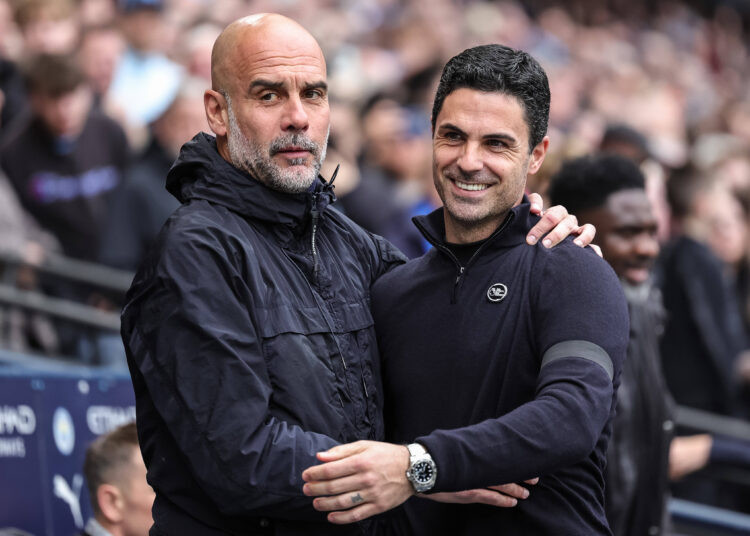
For years, Mikel Arteta was seen as Pep Guardiola’s most trusted lieutenant, the quiet tactician refining his craft under one of football’s great minds. Their relationship at Manchester City was built on shared ideas, long hours on the training ground, and a mutual understanding of positional play. But since the 2022/23 season, that dynamic has evolved into something far more compelling: a rivalry shaped by ambition, near-misses, and ultimately, redemption.
When Arteta returned to Arsenal, the early years were defined by rebuilding rather than competing. Guardiola, meanwhile, continued to set the standard at Manchester City, collecting titles with relentless efficiency. Yet by 2022/23, Arsenal had emerged as genuine contenders, pushing City deep into the season and signalling the beginning of a sustained challenge.
It was no longer mentor guiding pupil, but two elite managers locked in a battle for supremacy. What makes this rivalry unique is its underlying familiarity. Arteta understands Guardiola’s philosophy perhaps better than any other coach in Europe, while Guardiola has repeatedly acknowledged Arteta’s tactical growth. That mutual awareness has added layers to every encounter, turning matches into chess games as much as football contests.
Across four seasons, the narrative has shifted from promise to persistence, from heartbreak to history. The journey has not been linear for Arsenal, but it has been defining. In that time, Arteta has gone from apprentice to equal, and, eventually, to the man who could finally outlast his former mentor.
Jurgen Klopp once captured Arteta’s journey perfectly after Arsenal’s eventual title triumph, noting that “he had the mentality to stay when others would have walked away from a long fight with Pep.” It was a reflection not just of resilience, but of belief in a long-term vision that often appeared fragile.
Since the 2022/23 season, Arsenal have repeatedly come close without crossing the line. That campaign saw the Gunners lead for much of the year before Manchester City surged past them in the final stretch. The following seasons brought similar frustrations, complete with strong starts, periods of control, and then moments where experience and depth tilted the balance in City’s favour.
These setbacks tested Arteta’s project. Questions surfaced about whether Arsenal could truly sustain a title challenge against Guardiola’s machine. Yet, rather than dismantle the core, Arteta doubled down by refining his tactics, demanding more from his players, and slowly building a squad capable of enduring a full campaign.
Those failures were not collapses, but lessons. Each near-miss added a layer of maturity to the team, shaping a group that would eventually learn how to handle pressure rather than be consumed by it.
The 2023/24 season began with a symbolic victory before a ball was even kicked, as Arsenal secured Declan Rice from under Manchester City’s noses. It was a statement signing, both in quality and intent, underlining the North London club’s readiness to compete directly with Pep Guardiola’s side.
What followed was one of the closest title races in recent Premier League history. Arsenal and City traded momentum throughout the campaign, pushing each other to near-perfection. Arsenal displayed greater control and defensive solidity compared to the previous season, while City remained relentless in their pursuit.
Week after week, the margin for error disappeared. Arsenal showed they could respond to pressure, stringing together crucial wins, while City leaned on their experience in the run-in. Ultimately, it was Guardiola’s side that edged the title by just two points, a testament to their consistency in decisive moments.
For Arsenal, the disappointment was sharp but different from the year before. This time, they had gone toe-to-toe until the very end, proving they belonged at the highest level. The gap had narrowed, and the belief within the squad had strengthened.
The following season did not deliver the same intensity in the title race, even though Arsenal and Manchester City finished second and third, respectively. Injuries disrupted rhythm and continuity for both sides, preventing either from sustaining a prolonged push at the top.
Key players missed significant stretches, forcing both managers to rotate and adapt. Performances fluctuated, and consistency, which is paramount in a title race, proved difficult to maintain. While the final standings suggested competitiveness, the reality was that neither side truly imposed itself on the season.
Yet, beneath the surface, this campaign served an important purpose. It exposed the limitations in squad depth and highlighted the physical demands of competing across multiple fronts. For Guardiola, it reinforced the need for tactical flexibility within a stretched squad. For Arteta, it emphasized the importance of building a group capable of handling injuries without losing identity.
In hindsight, 2024/25 became a preparatory phase, a season that sharpened both teams ahead of what would become the most defining battle between Pep Guardiola and Mikel Arteta.
By the time the 2025/26 season unfolded, the Guardiola-Arteta rivalry had matured into the Premier League’s central storyline. Arsenal started strongly, asserting control at the top of the table for significant stretches and showcasing a balance that had been years in the making.
However, as had often been the case, Manchester City surged back into contention. Guardiola’s side closed the gap, applying familiar pressure and setting up another tense run-in. The psychological test for Arsenal was clear: could they hold their nerve when it mattered most?
This time, the answer was yes. Arsenal displayed composure, resilience, and a newfound authority in crucial fixtures. Rather than falter, they responded with decisive performances, ensuring that City’s late push would not derail their campaign.
When the season concluded, Arsenal stood as Premier League champions for the first time in 22 years. It was a historic achievement, but also a symbolic one. Arteta had not only matched Guardiola, but had finished above his mentor in consecutive seasons, becoming the first manager to do so during Guardiola’s managerial career.
It was the culmination of years of growth, setbacks, and persistence. The apprentice had not just learned from the master; he had surpassed him.
Just as the Guardiola-Arteta rivalry seemed poised to define a new era of English football, it reached an unexpected conclusion. The City manager’s announcement that he would step down from Manchester City brought a sudden halt to a contest that had only just reached its peak.
In many ways, this rivalry had everything required for longevity. There was tactical depth, personal history, and a competitive balance that promised shifting dominance rather than prolonged control by one side. Arteta’s Arsenal had finally cracked the code, while Guardiola remained as driven and innovative as ever. The stage was set for years of compelling battles.
Instead, what remains is a rivalry defined by its arc rather than its duration. From the early days of mentorship to the tension of repeated title races, and ultimately to Arsenal’s long-awaited triumph, it told a complete story within a relatively short span.
For Arteta, the timing of Guardiola’s departure adds another layer to his achievement. He not only ended Arsenal’s title drought but did so by overcoming the very benchmark he once helped build. For Guardiola, it closes a chapter where his influence extended beyond trophies, shaping a successor who could carry forward, and challenge, his ideas.
The Premier League will move on, as it always does, but this duel will linger in memory. It was not just about titles, but about evolution, belief, and the rare moment when a student rises to meet, and ultimately outgrow, the master.
