
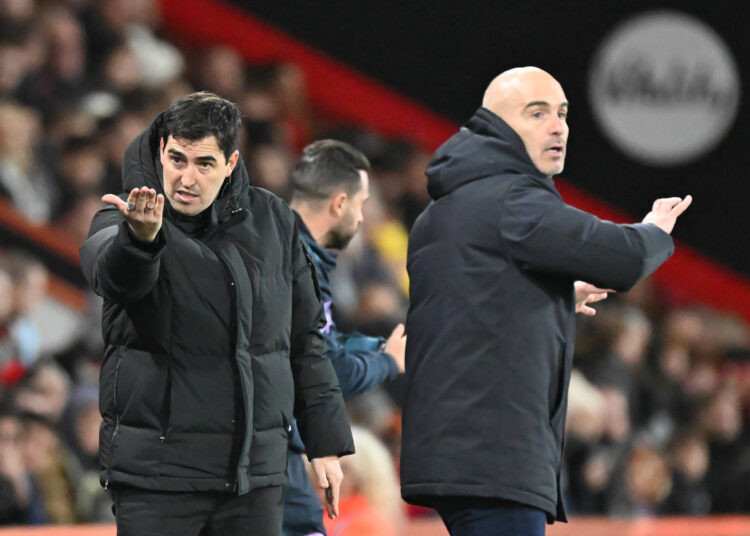
Liverpool vs Manchester City at Anfield on Sunday will provide an electric atmosphere as the Citizens return for the first time since the guilty verdict on their financial charges.
Manchester City’s independent commission verdict has cast a shadow over this fixture, but football will take centre-stage. Manchester City have made a perfect start to life under Enzo Maresca in the Premier League, while Liverpool still searching for their first home league victory under Andoni Iraola. The meeting is also the first Premier League clash between these clubs since March 2015 in which neither Jurgen Klopp nor Pep Guardiola is in the dugout.
After Arsenal were humbled 3-0 at Brighton & Hove Albion ahead of the international break, City have breathing room at the top of the table. Meanwhile, Liverpool must turn their unbeaten start into something more substantial. The points matter to the hosts without making this a decisive game.
They are sixth on nine points, but three draws from their opening five have stopped the campaign from becoming a clear push at the top. Their result would either provide the home win they have been waiting for or leave the same problem unresolved. The home side’s recent defensive improvement gives them a platform, as they have gone three matches without conceding.
On the other hand, City arrive with a different kind of pressure. Five wins from five have put them atop the Premier League table on 15 points, yet the fixture is still meaningful rather than campaign-defining. A victory would protect the perfect start and extend their authority; a draw would not damage their position in the short term, while defeat would give Liverpool a route back into the early title conversation.
Enzo Maresca has remained confident in his methods and the club’s leadership, with the squad focused on the football despite the verdict around it. Liverpool carry the need for progress, whereas City can approach the same match with more room to manage it. That difference should matter if the contest stays level deep into the second half.
Liverpool’s missing players change the attacking picture. Cody Gakpo (ankle) and Alexander Isak (thigh) are out after sustaining injuries on international duty. Meanwhile, Hugo Ekitike (achilles), Conor Bradley (knee), and Giovanni Leoni (knee) are long-term absentees. Federico Chiesa has resumed training and should be available.
The important consequence of Gakpo and Isak’s absence is felt in the centre-forward berth. Lewis Koumas becomes the natural option, so the selected 4-2-3-1 has to create a reliable reference for him rather than relying on the established choices.
The rest of Liverpool’s eleven is settled around that issue. Alisson Becker is an automatic pick between the sticks, with Ronald Araujo and Milos Kerkez starting as the two full-backs and Virgil van Dijk lining up alongside Jeremy Jacquet at the heart of the defence.
The double pivot should be Alexis Mac Allister and Dominik Szoboszlai, with Szoboszlai’s five starts producing 11 key passes and three created big chances. Florian Wirtz operates ahead of them as the central connector, while Bradley Barcola and Rio Ngumoha complete the attacking line around Koumas. Ngumoha has one goal from his five appearances, although only three were starts.
Koumas has played only 22 minutes across three Premier League appearances and has not started, but the available squad leaves him as the expected lead striker. That is a selection call with a direct tactical cost. Liverpool’s shape has been the 4-2-3-1 throughout the early period under Andoni Iraola, and the same structure should continue unless the match demands a different attacking solution.
Probable Liverpool Lineup (4-2-3-1): Alisson; Araujo, Jacquet, van Dijk, Kerkez; Mac Allister, Szoboszlai; Ngumoha, Wirtz, Barcola; Koumas
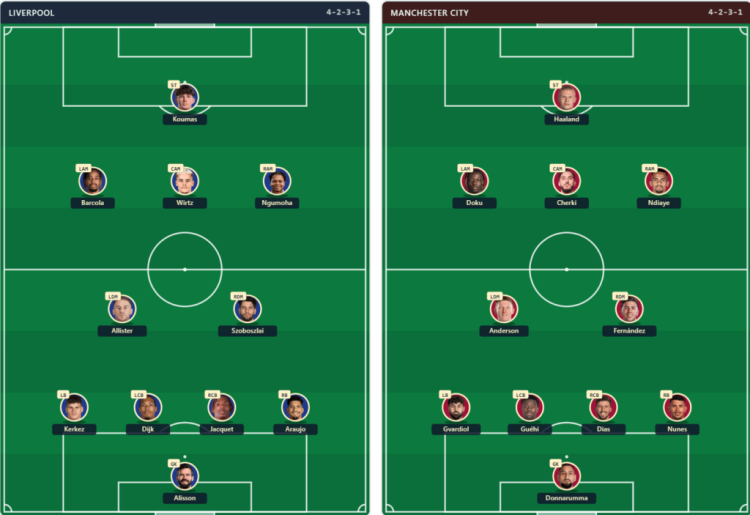
Probable Manchester City Lineup (4-2-3-1): Donnarumma; Nunes, Guehi, Dias, Gvardiol; Fernandez, Anderson; Ndiaye, Cherki, Doku; Haaland
Manchester City also have a settled 4-2-3-1 shape, but their left-hand side is less secure. Phil Foden is suspended as he completes his suspension after his dismissal in the Manchester Derby last month. Meanwhile, Nico O’Reilly may miss out after withdrawing from the England squad with a knock. Antoine Semenyo may also miss out due to a minor ankle complaint.
Gianluigi Donnarumma will take his spot in goal, with Matheus Nunes, Ruben Dias, Marc Guehi, and Josko Gvardiol forming backline. Elliot Anderson and Enzo Fernandez sit behind Rayan Cherki; Anderson has started all five Premier League matches and created two big chances, while Fernandez has one goal and four key passes from his four appearances.
Iliman Ndiaye is expected to start on the right wing, while Jeremy Doku deputises for Semenyo on the left. Rayan Cherki starts centrally behind Erling Haaland. The Frenchman has scored thrice while providing two assists and supplying 12 key passes from five Premier League appearances. Haaland leads the line after five starts, five goals, and 10 shots on target from 20 attempts.
Liverpool’s 4-2-3-1 setup is designed to keep two players behind Dominik Szoboszlai, place Florian Wirtz between the lines and give Lewis Koumas a clear central reference. The intention is to carry the match forward without abandoning the cover behind the press.
The visitors are the stronger side on ball control, but it is not a complete stylistic split. Both teams habitually want the ball, and Liverpool must decide whether their pressure can make City’s possession uncomfortable. Liverpool also use the long ball more often, with 52 per match against City’s 41 and a league-typical figure of 49.
That difference gives Koumas a possible route into the game when City close the shorter passing options, but it also risks returning possession to a team that is comfortable controlling it. The Reds have produced 13 shots per match against a league-typical 12.5, so the task is not simply to reach the final third; it is to turn that activity into chances without losing the midfield protection.
Manchester City’s version of the same formation keeps two midfield screens behind Rayan Cherki and leaves Erling Haaland as the fixed central reference. They will pursue the win, but they can also accept a draw without opening the game unnecessarily. Liverpool are more likely to carry the initiative inside their shape; City are more likely to preserve cover and wait for the home structure to stretch.
That is where the systems meet. Alexis Mac Allister and Dominik Szoboszlai must make the central pressure work against Enzo Fernandez and Elliot Anderson, while Florian Wirtz needs to find space around City’s double screen.
On Liverpool’s left, Bradley Barcola faces Matheus Nunes in the mirrored wide duel. If the Frenchman keeps Nunes pinned, Liverpool can sustain attacks high up the pitch. If Nunes contains him, City gain a safer exit and the home side’s pressure becomes easier to bypass. The decisive contest is central.
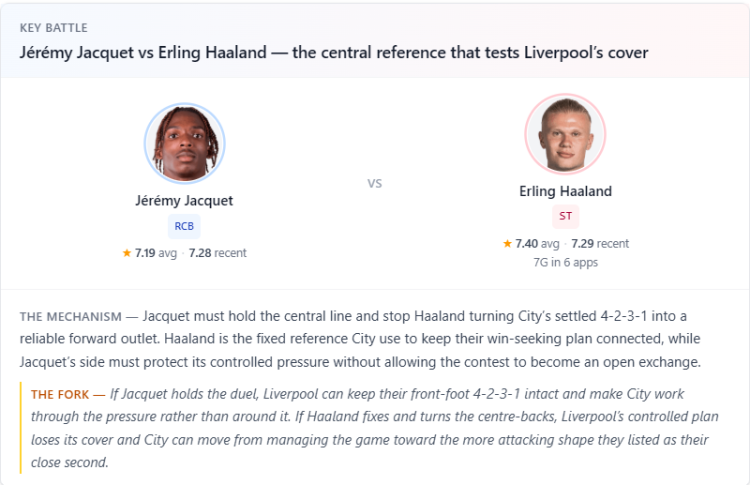
Jeremy Jacquet, in the midst of an impressive start to his Liverpool career, must prevent Erling Haaland from receiving, turning and making the 4-2-3-1 a dependable forward platform. Both players bring strong current form, but they perform opposite jobs: Jacquet protects the line, while Haaland fixes the centre-backs and gives City’s possession a destination.
There is limited room for Liverpool to lose that duel because Virgil van Dijk and Jacquet are the central cover behind the pressure; if Haaland turns one of them, Manchester City can attack the space before Liverpool recover their shape. If Jacquet holds the line, Liverpool can keep pressing without turning the match into an open exchange.
If Haaland dominates the contact and carries City forward, Liverpool’s controlled plan loses its protection. City could then add a third central midfielder through their 4-3-3 alternative, while Liverpool would be pushed towards their own extra-runner adjustment rather than retaining the selected shape.
We predict Manchester City to win, albeit with medium confidence. Their perfect start is part of the case, yet the stronger football reason is how their central structure can cope with Liverpool’s pressure. Enzo Maresca’s men have averaged 1.81 expected goals thus far, compared with Liverpool’s 1.39, and their attack has run 2.98 goals above expectation while Liverpool’s has sat 2.215 below it.
That points to a better route for City when the match reaches the penalty areas, particularly with Erling Haaland occupying the central areas and Rayan Cherki supplying him. Liverpool’s strongest route to a win is to make the game physical and uncomfortable before the visitors assert their control.
Their defensive run means the front-foot approach has protection behind it, and Jeremy Jacquet’s ability to hold Haaland could allow Florian Wirtz and Dominik Szoboszlai to keep the home side high. If Bradley Barcola also prevents City from escaping cleanly on their right, the home side can produce the sustained pressure that their home record has so far lacked.
The strongest case against the away win is therefore not simply home advantage. It is Liverpool forcing City to defend longer than they prefer, then using Wirtz between the lines and Szoboszlai’s delivery to compensate for the missing centre-forward options. City’s approach could become a problem if it turns into passive defending and allows Liverpool to build repeated attacks. The expected scoreline range is 1-2, 0-1 or 1-3.
The managers have a clear adjustment available if the first plan stops working. Liverpool can move to a 4-3-3 after the interval to add another runner between the lines, while Manchester City can use the same formation to introduce a third central midfielder and control the second half. The side that makes that change without losing its defensive cover should have the better chance of turning a balanced opening into the result it wants.
