
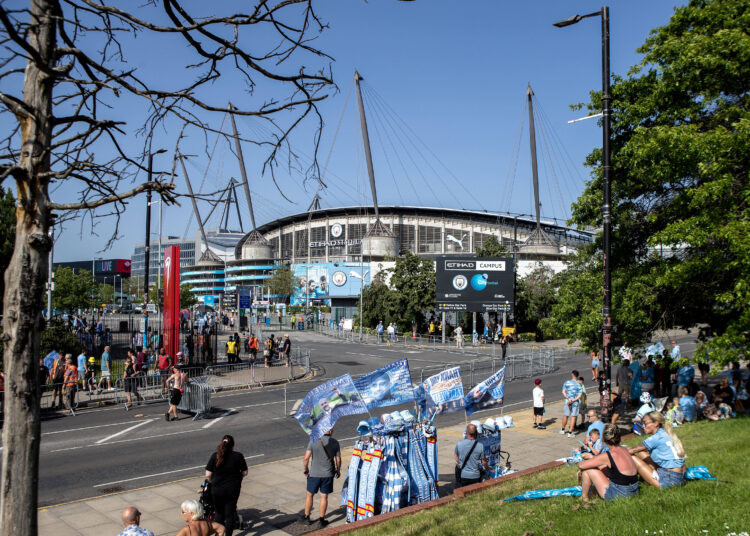
Manchester City vs PSG at the Etihad on Wednesday night will feature two powerhouse teams eager to build on impressive wins on the weekend and continue their perfect starts to their UEFA Champions League campaigns.
Manchester City responded to a guilty verdict on Premier League financial-regulation breaches with a commanding 3-0 win away at Liverpool. That result gives this UEFA Champions League meeting a different edge with PSG. City arrive with confidence and a clear ability to absorb external pressure, while Les Parisiens come to the Etihad as the back-to-back European champions after a less convincing domestic spell.
This is a meaningful group-progression fixture for both sides, though they can absorb a setback at this stage. City can strengthen the authority of their recent run with another major victory, while PSG can protect their European standing with a result away from home. That shared room for caution is important because both teams have enough attacking quality to punish a match that becomes too open.
For City, the value of the result is tied to proving that the Liverpool performance was more than a response to noise around the club. Their latest away display was direct and efficient, and it followed a long winning sequence across competitions. They carry that momentum into this game, along with the confidence provided by four clean sheets in their recent five-match run.
PSG have a different problem to solve. Their recent run has been entirely positive, but the 3-1 win over promoted Le Mans required Luis Enrique to introduce four first-team players around the hour mark. That raised questions about how smoothly the rotation group is integrating, even as their European pedigree remains formidable.
The away side can pursue the win without turning the match into a chase, and that should encourage a measured opening rather than an immediate exchange of attacks. Senny Nsona Mayulu remains a doubt with a thigh-muscle strain, while Alessandro Longoni is out with a dead leg; neither call is expected to alter the central structure of the projected side.
Manchester City should line up in their established 4-2-3-1 setup, with Gianluigi Donnarumma behind a back four of Josko Gvardiol, Marc Guehi, Ruben Dias, and Matheus Nunes. City want protecting the area behind their midfield rather than changing the defensive platform that has served them well recently.
Enzo Fernandez and Elliot Anderson should form the double pivot. Fernandez is him the most productive organiser in City’s midfield, while Anderson is expected to provide the other side of the protection. Rayan Cherki starts centrally as the main creator; his role is particularly important because City need a player between PSG’s midfield and defence without sacrificing the extra body behind him.
The front line should feature Antoine Semenyo from the right, Jeremy Doku from the left wing and Erling Haaland through the middle. City’s plan should remain clear. Keep the double pivot available behind the ball, find Cherki between the lines, and use Haaland as the reference point when the attack becomes more direct.
Probable Manchester City Lineup (4-2-3-1): Donnarumma; Nunes, Dias, Guehi, Gvardiol; Anderson, Fernandez; Semenyo, Cherki, Doku; Haaland
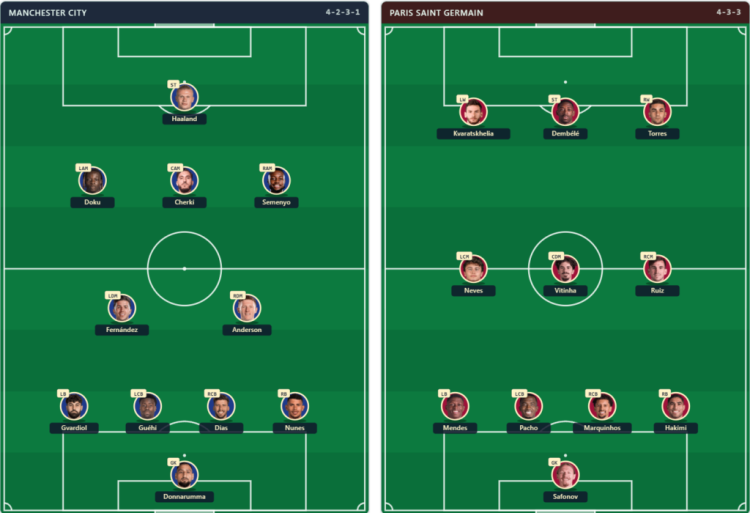
Probable PSG Lineup (4-3-3): Safonov; Hakimi, Marquinhos, Pacho, Mendes; Ruiz, Vitinha, Neves; Torres, Dembele, Kvaratskhelia
PSG will line up in a 4-3-3 formation vs Manchester City. Matvey Safonov will take his place in goal, with Achraf Hakimi and Nuno Mendes at full-back, and Marquinhos alongside Willian Pacho in the centre. Marquinhos’s main task will be to keep the line connected to the midfield rather than follow Haaland too far.
Vitinha anchors the midfield behind Joao Neves and Fabian Ruiz. Vitinha gives PSG their first passing option when City try to close the middle. Ruiz can support attacks rather than simply circulate possession. Finally, Ferran Torres and Khvicha Kvaratskhelia should flank Ousmane Dembele. The Ballon d’Or winner’s recent European-level output makes him PSG’s clearest attacking reference, though his movement may take him away from the central lane at times.
Manchester City’s 4-2-3-1 system is designed to preserve two players in front of the centre-backs while giving Rayan Cherki a central platform behind Erling Haaland. The shape should let City seek the win without committing every midfielder beyond the ball.
PSG’s 4-3-3 setup, on the other hand, offers a different route. Vitinha can sit at the base, Fabian Ruiz, and Joao Neves can support circulation, and the wide forwards can stretch City’s back four before Ousmane Dembele attacks the space that opens.
Neither side is expected to treat the match as an all-or-nothing chase. City’s recent display against Liverpool showed that they can bypass a slower build-up when the opponent gives them a reason to play long. However, this fixture asks whether they can keep that directness connected to their controlled structure. PSG’s possession game will test the double pivot, especially if Vitinha receives behind Cherki and can turn toward City’s backline.
The wider contest is also important. Jeremy Doku’s movement on City’s left meets Achraf Hakimi on PSG’s right, with both players having to balance attack and defensive responsibility. If the Belgian winger forces Hakimi backwards, PSG lose some of the width and progression that make their 4-3-3 stable. If the PSG full-back advances cleanly, City may have to defend deeper and rely more heavily on their central pair to launch the next attack.
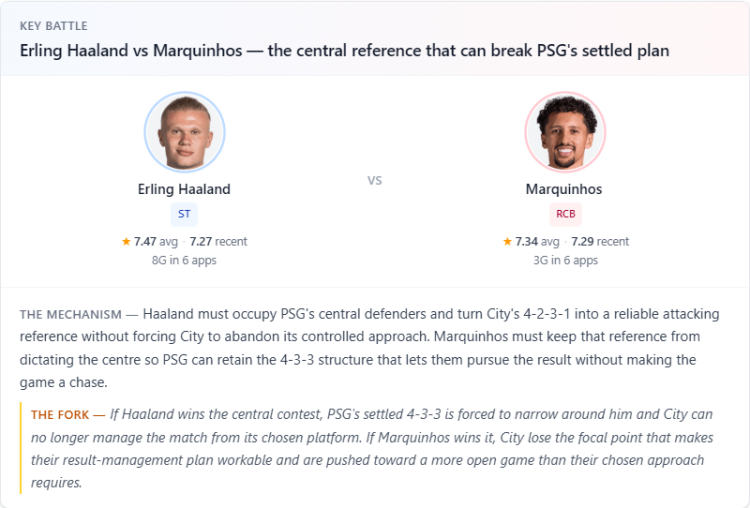
The decisive duel is Erling Haaland against Marquinhos. The Manchester City striker needs to occupy the central defenders and make City’s formation a reliable attacking platform without forcing the home side into a more open game. Marquinhos has to prevent the Norwegian from dictating the centre so PSG can retain their shape and pursue the result on their own terms.
Behind Haaland, Cherki can exploit any gap created by the striker’s movement; in front of Marquinhos, Vitinha is the player who must help PSG avoid being pinned close to their penalty area. If Haaland wins the contest, PSG may have to narrow around him, which would give City more room to manage possession and attack the second ball.
If Marquinhos wins it, City lose the focal point that makes their controlled approach workable and may be pulled into a more open match than they want. That is why the duel matters beyond the two players; it changes whether each midfield can perform its intended job.
We predict a draw, though the confidence is low rather than firm. Manchester City have conceded 1.17 expected goals per match across their recent five-match patch and kept four clean sheets in that period, giving them the better defensive platform. PSG, however, average 3 xG over the same window, the sharper attacking baseline in this fixture.
Those figures point in opposite directions rather than producing a clear winner. The strongest case against the draw is PSG’s attacking ceiling. If Vitinha finds a reliable route through the double pivot, Ousmane Dembele and Ferran Torres can attack the spaces around City’s centre-backs before they settle into their defensive structure.
PSG’s limited defensive protection keeps the other side of the match live, though. They have kept only one clean sheet in the same five-match sample. So, Erling Haaland and City’s left-sided attack should have opportunities if PSG’s wide structure loses its compactness.
The scoreline range is 1-1, 2-2 or 2-1. The first two outcomes fit a contest in which both sides create enough without fully taking control; the final one reflects City’s home advantage and stronger recent defensive record.
The selection call that could alter the game is PSG’s choice between the expected 4-3-3 setup and the narrower 4-3-1-2 shape. Staying with the wider system gives Achraf Hakimi and Nuno Mendes clearer lanes to support the forwards.
However, moving to the narrow alternative would add another player closer to Ousmane Dembele and potentially help PSG contest the central area around City’s double pivot. That change would also leave more responsibility on the full-backs to provide width, making the opening selection important even if the match begins cautiously.
