
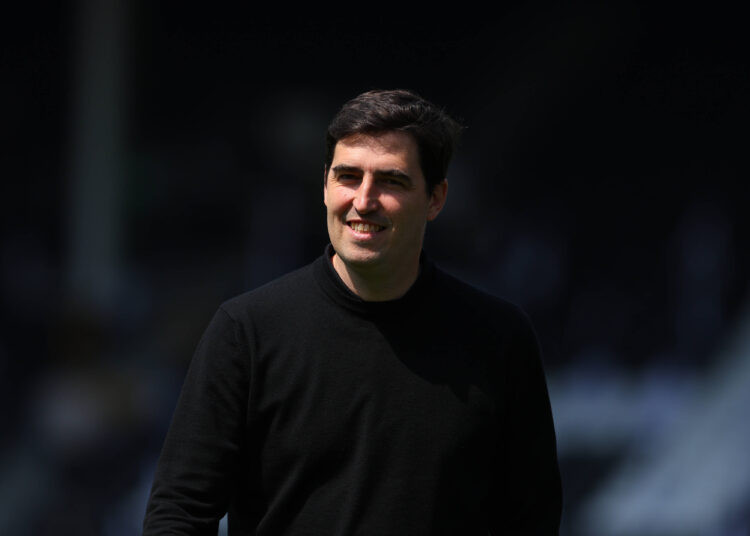
Fenerbahce vs Liverpool at the Sukru Saracoglu Stadium on Wednesday will be a match between two teams on opposite of the UEFA Champions League table after the first three rounds.
Fenerbahçe’s latest European night turned from a commanding position into another warning sign: they led Slavia Praha 2-0 before conceding a late equaliser, while Liverpool arrive after a 1-0 defeat to Arsenal at Anfield. Those results frame this meeting differently for the two clubs. Fenerbahçe are trying to stop a damaging Champions League run from becoming a deeper crisis; Liverpool are looking to ensure a domestic setback does not interrupt their perfect start in Europe.
The result is worth recovery for the home side and progression for the visitors. Fenerbahçe have gone nine Champions League matches without winning, including a 6-0 defeat by Aston Villa and the collapse against Slavia. Liverpool, meanwhile, have won all three of their European games, including a 4-3 victory over Villarreal after falling two goals behind. The match should therefore be competitive in its stakes even if Liverpool bring the more convincing recent platform.
For Fenerbahçe, a win would give Dirk Kuyt’s interim regime something solid to build around after his opening match ended in a 2-1 defeat to Göztepe. A draw would at least halt the European slide, but another defeat would leave the club searching for answers with little time to restore confidence. Their recent Champions League record has been particularly damaging: the heavy loss at Aston Villa was followed by the failure to protect a two-goal lead at home to Slavia. The side carries urgency, but also the risk of playing from anxiety rather than control. The uncertainty around Mason Greenwood could further reduce their attacking options, depending on whether he is able to take part.
Liverpool’s European position is far healthier, though the Arsenal defeat gives this trip a slightly different edge. They can protect a perfect continental record and show that the new project under Andoni Iraola can respond immediately to a difficult domestic result. Their three European wins have featured 2-1 against Atlético Madrid, a 6-3 victory at LASK and the dramatic Villarreal comeback. That run gives them attacking belief, while their established structure offers a way to avoid turning this into another uncontrolled exchange. Liverpool can accept a patient win rather than chase a statement performance.
Fenerbahçe are missing Nathan Ake, Marco Asensio, Mert Hakan Yandaş, Jayden Oosterwolde and Amara Diouf, while Greenwood is doubtful with flu and Kojo Oppong is also doubtful after pulling up late against Göztepe. Ake and Oosterwolde reduce the defensive cover available to the side, Asensio removes an attacking option, and the two doubtful calls affect how much attacking depth Kuyt can call on. The projected structure consequently keeps protection in front of the back four rather than sacrificing a midfielder for another attacking line.
The home side should start in a 4-2-3-1. Ederson holds goal behind Levent Mercan, Archie Brown, Milan Škriniar and Nélson Semedo, with Mercan and Brown filling the less settled defensive positions. Škriniar brings continuity on the right of the centre-back pairing, having started four matches and played 360 minutes, while Semedo has three starts and one assist. The defensive unit is therefore not simply about names; it is about asking a partly reshaped back four to stay connected against Liverpool’s movement between the lines.
N’Golo Kanté and Mattéo Guendouzi should form the platform. Kanté has started three matches and completed 270 minutes, while Guendouzi has the same number of starts and has supplied four key passes. Kanté is the deeper security, with Guendouzi expected to help carry the ball and support the next phase. İrfan Can Kahveci starts ahead of them as the central creator after producing five key passes and creating two big chances in his three appearances. His position is important because Fenerbahçe need a route from the double pivot to the striker without immediately abandoning their compact shape.
Kerem Aktürkoğlu and Oğuz Aydın should occupy the wide attacking positions, with Aydın offering the more established recent contribution: one goal, seven key passes and two big chances created in four appearances. Vedat Muriqi leads the line. He has started all four of his appearances, with one goal and six shots on target from seven attempts, and his ability to hold the ball will determine whether Fenerbahçe can move out of their own half. The rest of the projected eleven is settled around those functions: protect centrally, find Kahveci, and use Muriqi as the release point.
Liverpool also use a 4-2-3-1, and their absentees are Federico Chiesa, Wataru Endo, Jeremie Frimpong and Hugo Ekitiké. Frimpong’s absence means the visitors must rely on their available full-back options for width rather than a specialist attacking outlet from that position. The other absences narrow the forward and midfield rotation, but the expected starting structure remains familiar.
Alisson starts behind Konstantinos Tsimikas, Virgil van Dijk, Jérémy Jacquet and Ronald Araujo. Van Dijk has made two starts and played 208 minutes, while Araujo has added two goals and an assist from three starts. Alexis Mac Allister and Ryan Gravenberch sit in the double pivot, with Mac Allister the main organiser after scoring three goals and making six key passes in his three appearances. Florian Wirtz operates between the lines; he has eight key passes, two big chances created, one goal and one assist from three appearances.
Bradley Barcola should start on the left after recording an assist and three key passes in his only appearance. Víctor Muñoz takes the opposite wide position, while Alexander Isak leads the line. Isak has one assist from two appearances, but Liverpool will ask him to occupy the centre-backs and give Wirtz and the wide players a fixed reference. That gives the visitors a clear route through the pitch without needing to force every attack.
Both sides are expected to use the same 4-2-3-1 system, but the purpose is not identical. Fenerbahce’s shape is designed to keep two midfielders behind the attacking line, protect the centre-backs and give Vedat Muriqi an outlet. They want to restore control without making a vulnerable team even more open.
Liverpool’s version, on the other hand, preserves two supports for Alexis Mac Allister, leaves Florian Wirtz between the lines and keeps Isak as the lone reference. It is a structure built to press an advantage without turning the match into a series of rushed transitions.
The away side’s profile points to a side that keeps the ball around the league’s normal level, with 53 per cent possession against a typical 53 per cent. Their wider attacking habit is clearer. They produce 19 crosses per match compared with a league figure of 15.
The visitors should therefore be able to circulate through Mac Allister and Wirtz before using Kostas Tsimikas, Ronald Araujo, Bradley Barcola, or Victor Munoz to deliver from wider areas. Fenerbahce’s response is more about preserving shape than matching Liverpool on a statistical axis. The key meeting is in the middle.
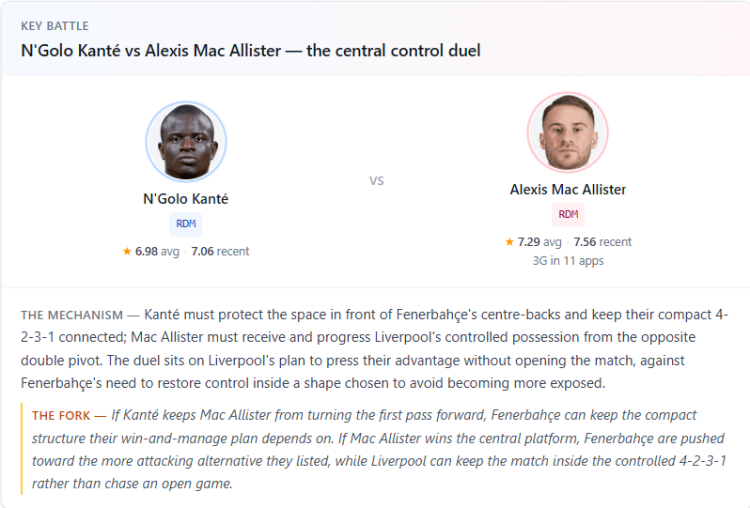
N’Golo Kante has to prevent Mac Allister from receiving cleanly and turning the first pass forward, because Liverpool’s control becomes much easier when their central leader can play through the pressure. The Argentine international, in turn, must find a way past the home side’s two-man screen without forcing Liverpool into the open game they would prefer to avoid.
Behind Kante is a centre-back pairing already carrying extra responsibility; behind Mac Allister is a Liverpool structure that can continue to attack through Wirtz if the first duel is won. If the Frenchman controls that space, Fenerbahce can remain compact and give themselves a chance to release Muriqi into the next phase.
If Mac Allister wins it, the home side may have to turn to the more attacking 4-3-3 option, placing greater demands on a defence that has not looked secure. The central contest is therefore not just about possession. It decides whether Fenerbahce can keep their intended safeguards or must abandon them. The second important collision is Muriqi against Virgil van Dijk.
Muriqi’s role is to make the home shape playable by holding the ball centrally; van Dijk’s task is to remove that outlet and keep Liverpool’s backline from being pulled into repeated retreats. If the Fenerbahce striker can bring the wide attackers and Irfan Can Kahveci into the game, the home side can advance with both holders still behind the ball.
If van Dijk wins the first contact consistently, the home side may be forced into longer clearances and deeper defending, leaving Liverpool to recycle attacks. The away side’s width adds another layer. Their crossing volume and set-piece threat can test Fenerbahce without requiring the visitors to abandon their controlled shape.
The hosts must defend the initial delivery and the second ball while keeping Kante and Matteo Guendouzi close enough to protect the centre. If those distances stretch, Wirtz can find room behind the midfield and Alexander Isak can attack the centre-backs with fewer defenders around him.
We predict Liverpool to win, albeit with medium confidence rather than treated as a safe result. The visitors have the more settled route through the match. Alexis Mac Allister can connect the double pivot to Florian Wirtz, the wide players can supply the striker, and the 4-2-3-1 system has been their repeated reference point.
Fenerbahce’s plan is understandable, but it depends on maintaining compactness for long periods after a run in which defensive control has repeatedly failed. The strongest case against Liverpool is that their preference for managing the game could give the hosts enough time and territory to stay alive.
If Vedat Muriqi holds the ball, Irfan Can Kahveci finds pockets behind the midfield and Oguz Aydin attacks the space outside Liverpool’s left side, the home team can make the visitors defend more often than planned. Fenerbahce have already shown against Slavia Praha that they can create a lead before losing control.
Liverpool’s recent defensive record also leaves room for a home goal, especially if the match produces repeated wide deliveries and second phases around the box. Even so, the recent attacking and defensive aggregates favour Liverpool. They average 1.93 xG across their last five matches, while Fenerbahce have 2.24 xGA per game across their last two Champions League ties.
The home side have also kept no clean sheets in that period. Those figures point to Liverpool creating the better chances, while Fenerbahce’s route to success depends on an improvement that has not yet become reliable. The most likely scoreline range is 1-2, 0-1 or 1-3. Liverpool should have enough control to win, but Fenerbahce’s need for a response makes a narrow home contribution plausible.
The selection that could alter the match is Fenerbahce’s move to a 4-3-3 setup if an additional attacking midfielder is confirmed fit. That change would add another line around Liverpool’s penalty area and could help the home side turn Vedat Muriqi’s hold-up play into sustained pressure, but it would also remove one layer of protection from the centre.
Liverpool’s response would be to keep Alexis Mac Allister facing forward and use Florian Wirtz in the space created around the remaining midfielder. The timing of that switch may decide whether Fenerbahce finish the match chasing an equaliser or protecting their structure.
