
Borussia Dortmund have confirmed that they will not renew their controversial sponsorship agreement with German arms manufacturer Rheinmetall, bringing an end to a partnership that has drawn sustained opposition from the club’s supporters since its introduction in 2024.
The Bundesliga club announced on Friday that the existing agreement will expire as scheduled on June 30, 2027. Rheinmetall, which became a BVB Champion Partner in May 2024, currently advertises on the club’s stadium hoardings and other commercial platforms but does not appear on Dortmund’s shirts.
According to Kicker, the agreement has generated a high single-digit million-euro sum annually for the club. Previous reporting placed the sponsorship’s value at approximately €10 million per season.
The decision marks the conclusion of a dispute that has occupied Dortmund’s leadership, members, and organised supporter groups for more than two years. Get German Football News reported in October that newly appointed BVB CEO Carsten Cramer was already inclined to allow the partnership to expire despite Rheinmetall’s desire to extend the commercial relationship.
The sponsorship proved contentious almost immediately after its announcement ahead of Dortmund’s appearance in the 2024 Champions League final. Supporters questioned the compatibility of a football club’s commercial activities with the promotion of a company manufacturing military equipment. Others within Dortmund’s leadership defended the partnership by emphasising the importance of defence and security in a changing European political environment.
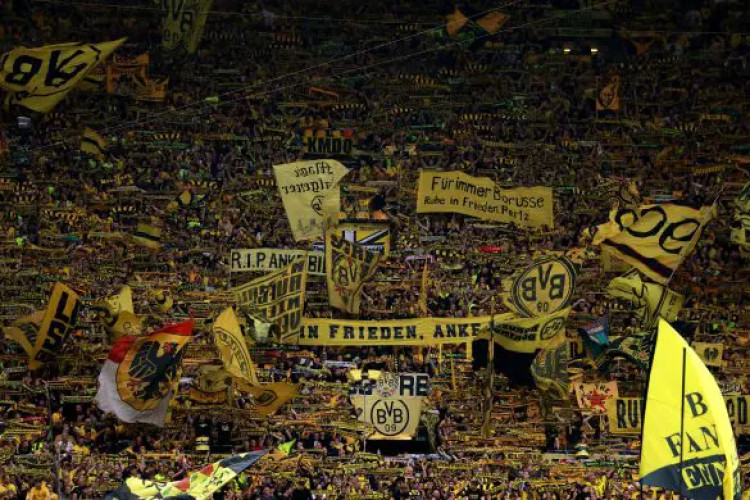
Opposition became particularly visible during Dortmund’s opening Bundesliga home fixture against Eintracht Frankfurt in August 2024. More than 90 organised fan clubs and supporter groups had backed the coordinated protests, while demonstrators outside Signal Iduna Park displayed symbolic red cards and a mock tank carrying a message criticising Rheinmetall’s relationship with the club.
Numerous banners appeared inside the stadium, with sections of the Südtribüne also withholding vocal support temporarily.
The protests continued throughout the partnership and eventually led to a formal expression of opposition from Dortmund’s membership. At the club’s November 2024 general meeting, 556 members voted in favour of a motion opposing the sponsorship and calling for its earliest possible conclusion. There were 247 votes against and 52 abstentions.
The membership decision was not legally binding on the management of Borussia Dortmund’s publicly listed professional football company. Nevertheless, it established a clear position among participating members and remained an important part of the subsequent discussion.
The vote represented a significant escalation of the supporter campaign against the agreement.
Borussia Dortmund president Hans-Joachim Watzke, who helped establish the partnership during his tenure as the club’s chief executive, recently acknowledged that he had underestimated the strength of opposition among Dortmund supporters.
Speaking on the AUSGERECHNET podcast, where he also addressed the recent controversy involving midfielder Felix Nmecha, the 67-year-old reiterated that he continued to regard Rheinmetall as an important German company while recognising why many members opposed the club advertising on behalf of a weapons manufacturer.
“That is something I personally may have misjudged at the time,” Watzke admitted. “I remain convinced that Rheinmetall is a company that reflects well on Germany. But I underestimated how many Dortmund supporters, decent people, told me: ‘We are not against Rheinmetall. We just don’t want Borussia Dortmund advertising for someone who manufactures weapons.'”
Watzke stressed that he did not necessarily have to adopt that position himself but fully accepted the concerns expressed by supporters. The former chief executive also urged Dortmund’s current management to take the membership vote into account when deciding the partnership’s future.
Current Dortmund CEO Carsten Cramer, who had previously defended the commercial agreement, acknowledged on Friday that the decision had not been straightforward.
“We are aware of the criticism from our members and sections of our supporters,” Cramer explained. “Naturally, we took this aspect into account and treated it seriously in our discussions with Rheinmetall.”
Cramer linked the decision to Dortmund’s commitment to the 50+1 principle and the importance of maintaining unity within the club.
“If we are so clearly committed to 50+1, and if the cohesion and unity of BVB are as important to you as they are to me, then we must engage with all the perspectives and considerations of our stakeholders and ultimately make a decision.”
