
Ipswich Town vs Aston Villa at Portman Road on Saturday will be a battle of two bottom-half teams eager to return to winning ways and build momentum going into the festive period.
Aston Villa dominated Sunderland but could not turn control into a goal, while Ipswich were beaten 2-0 by Tottenham after conceding what Gary O’Neil called “really soft” defending. Those results frame this meeting/ Ipswich are trying to stop their defensive problems deciding matches, while Villa need their possession to produce something more threatening in the final third.
The result is meaningful for Ipswich rather than decisive. A win would give them an important lift at home, but another defeat would deepen the pressure around a team that has now gone 30 consecutive league matches without a clean sheet. Their immediate task is not simply to attack Villa; it is to avoid giving the visitors another cheap route into the game.
Villa arrive with a different problem. They have drawn three league matches in succession and are looking for the win that would turn a period of control without enough cutting edge into progress. Another draw would extend that stalled run, while defeat would make their failure to convert possession into results harder to ignore. Their recent unbeaten league sequence gives them a platform, but not much room for another flat attacking display.
Ipswich Town have nobody unavailable for the game vs Aston Villa this weekend. Their expected 4-2-3-1 shape keeps two holding midfielders behind Julio Enciso, with Christian Walton in goal and Dara O’Shea and Issa Diop forming the central defensive pairing. Leif Davis should continue at left-back after recovering from a minor ankle issue, while his 10 key passes rank third in the squad.
Abdoul Ouattara is expected on the other side, with Florentino Luis and Exequiel Palacios providing the deeper midfield base. Enciso is the selection around which Ipswich Town’s attacking structure is built. He has started 11 Premier League games, registering two goals, two assists, and 16 key passes, the most in the squad.
Emersonn should lead the line after contributing two goals and one assist in 11 appearances, while Jaden Philogene is likely to get the left attacking slot despite a quieter current spell. Abdul Fatawu Issahaku is expected on the right.
Probable Ipswich Town Starting Lineup (4-2-3-1): Walton; O’Shea, Diop, Greaves, Ouattara; Lukic, Palacios; Clarke, Enciso, Maeda; Emersonn
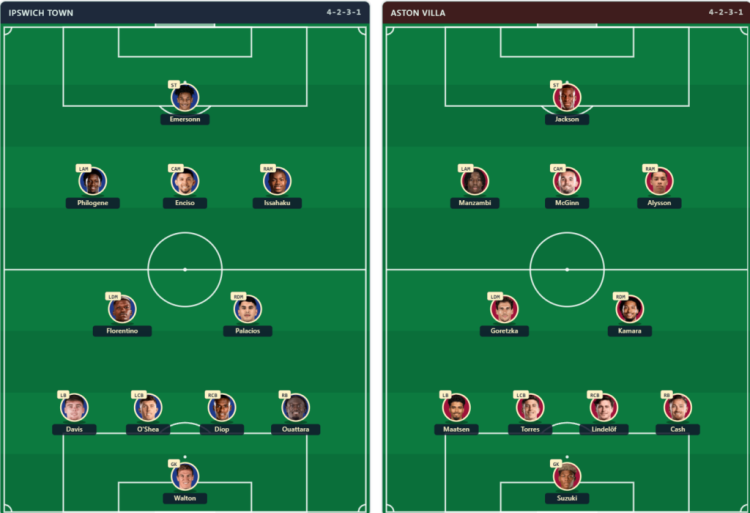
Probable Aston Villa Starting Lineup (4-2-3-1): Suzuki; Cash, Lindelof, Torres, Maatsen; Kamara, Goretzka; Alysson, McGinn, Manzambi; Jackson
Aston Villa will be without Amadou Onana, who remains a long-term absentee due to a knee injury and is targeting a spring return, while Matteo Ruggeri is out with a hamstring injury and is expected back around the end of November. Onana’s absence removes a midfield option from the squad, but the predicted shape still has Leon Goretzka and Boubacar Kamara as the double pivot.
The visitors should retain their settled 4-2-3-1 shape. Zion Suzuki is an automatic pick between the sticks behind Pau Torres and Victor Lindelof, with Matty Cash at right-back and Ian Maatsen at left-back. John McGinn remains the central attacking link. The skipper has two goals, four assists and 21 key passes, the highest total in the squad, and his penalty duty adds another responsibility.
Johan Manzambi should provide the left-sided outlet after two goals and three assists in seven starts. Alysson is expected to keep the right attacking position, where his two goals from 10 appearances offer a modest scoring contribution. Nicolas Jackson is the fixed reference point up front. He has scored six goals and added an assist in 10 starts, giving Villa the clearest established finisher in either attack.
Both sides are expected to use the 4-2-3-1 formation, but they will not use it in the same way. Ipswich Town should carry the match towards Aston Villa and accept some exposure in doing so. Their two deeper midfielders give Julio Enciso room to operate ahead of them, while the wide attackers and full-backs provide routes around Villa’s central block.
The occasional switch to three centre-backs is the safety valve if that approach produces a lead. The visitors should seek the win without turning the match into an uncontrolled chase. Their double pivot can screen the defence while John McGinn connects the midfield to Nicolas Jackson, and the shape gives them enough attacking support without abandoning cover.
They are more likely to accept a draw if the match becomes stretched than to force every attack forward. The profiles point to a direct contest rather than a clear possession battle. Ipswich have averaged 48% of the ball and Villa 45%, against a league typical figure of 48.5%. Neither side normally dominates possession, so the important question is what happens after the first pass forward.
Ipswich have produced 51 long balls per match against a typical 50, whereas Villa have played 42 against that same benchmark. That difference gives the home side the more natural route into a physical, forward game. The Tractor Boys also attempt more take-ons, with 16 per match compared with Villa’s 14, against a league typical 14.
The away side’s shooting volume is higher; they average 13 attempts to Ipswich’s 11, with the league figure also at 13. Unai Emery’s men therefore have the greater appetite to finish attacks, but Ipswich have more ways of making the first phase uncomfortable.
Villa’s recent 0-0 draw with Sunderland showed the risk in their plan. They had 72% possession and 18 shots but still failed to score, so simply holding the ball will not be enough here. Their season attacking average is 1.40 xG, compared with 0.98 for Ipswich, yet Villa’s control must become chances before their more measured approach can take hold. The first major contest is Leif Davis against Alysson.
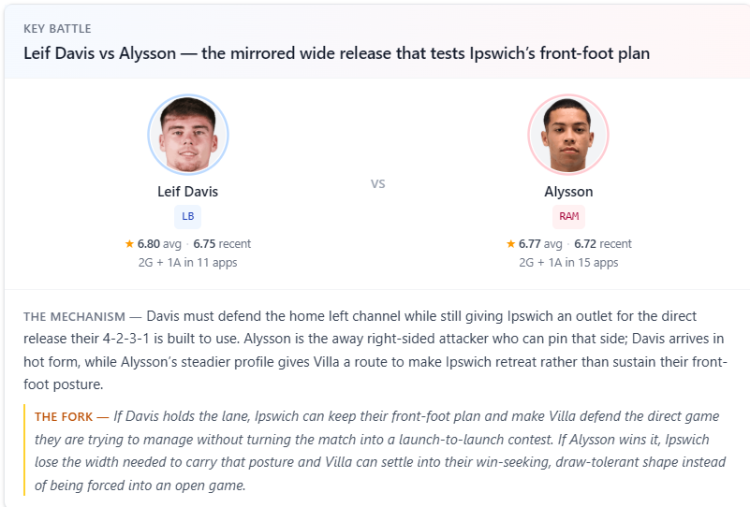
Davis has to defend Ipswich’ Town’s left-side channel while still supplying the direct outlet that allows the home side to play forward. Alysson can pin him deeper and force Ipswich to retreat, but Davis brings the stronger current form into that duel.
If the full-back holds the lane, Ipswich can keep their aggressive plan and make Villa defend the direct game. If Alysson wins it, the hosts lose the width that supports their approach and Emery’s men can manage the match on their own terms. The central Enciso-Kamara contest adds a second layer.
Enciso wants to receive between Aston Villa’s midfield and defence, while Kamara is the player responsible for keeping that space controlled. If Kamara keeps Enciso in front of him, Villa can preserve the balance of their shape and avoid opening the match. If Enciso escapes the screen, Villa lose the control that makes a draw acceptable and Ipswich can keep moving the game towards their preferred territory.
We predict a draw, but only with low confidence. Ipswich Town’s direct approach can disturb Aston Villa’s controlled build-up, while the central space around Julio Enciso gives the hosts a way to create chances even without dominating the ball.
The visitors have the stronger attacking underlying numbers, but their recent difficulty turning possession into goals makes an away win less convincing than their overall quality suggests. The strongest case against the draw is Villa’s ability to expose Ipswich’s defensive record.
Unai Emery’s men average 1.40 xG per match against Ipswich’s 0.98, while the hosts have 2.26 xGA and Villa concede 1.82 across the recent five-match window. Gary O’Neil’s men have kept no clean sheets in that run, so Nicolas Jackson and John McGinn have a credible route to punish any loose defending.
If Aston Villa convert their territorial control earlier than they did against Sunderland, the match can move towards an away win. The likely scoreline range is 1-1, 2-2 or 1-2. That reflects a match in which Villa may create the better chances but Ipswich can keep finding direct deliveries and second phases around the box.
Ipswich have a clear in-game adjustment if the match turns in their favour. They can move to a 3-4-2-1 setup and add another centre-back to protect a lead. That would bring extra cover behind the midfield and place two attacking players closer to Emersonn, trading some natural width for defensive security.
Aston Villa’s predicted shape has no comparable change identified, so the final stages may depend on whether Gary O’Neil trusts the original 4-2-3-1 or protects the result with the back three.
