
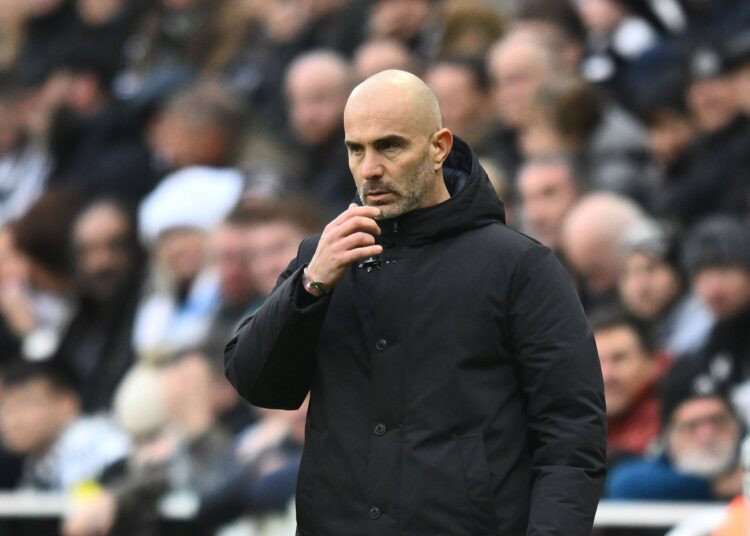
Enzo Maresca’s appointment as Manchester City manager marks one of the most intriguing managerial successions in modern Premier League history.
Stepping into the void left by Pep Guardiola, Enzo Maresca arrives not as a radical departure from the City blueprint, but as someone deeply embedded in it, both as a former assistant and as a long-time disciple of its footballing philosophy. The central question is no longer whether he understands the system, but whether he can evolve it while carrying the crushing expectation of sustaining City’s dominance.
Maresca’s journey to the Etihad has been unusually direct for a top-level successor. He previously worked within the City structure as head coach of the Elite Development Squad, where he developed players such as Cole Palmer and instilled positional patterns that mirror those of the first team.
The Italian tactician also served under Pep Guardiola during the 2022/23 treble-winning campaign as part of the coaching setup, absorbing the tactical and methodological details that defined that era. This internal lineage matters. City have not hired an outsider, but someone shaped by their own footballing ecosystem.
Before returning to Manchester, Maresca built his reputation step by step. At Leicester City, he delivered immediate promotion from the EFL Championship, winning the title with near-record consistency. His Chelsea spell was more turbulent in terms of club politics, which has reared its ugly head again upon his move to City.
However, it still featured tangible success: a top-four league finish and two trophies, the UEFA Conference League and the FIFA Club World Cup. His Chelsea side showed clear patterns of structured possession, high expected-goal creation, and positional rotations designed to manipulate space rather than rely on individual brilliance. Even in a volatile environment, his system consistently produced attacking output.
Tactically, Maresca is often described as a “Guardiola continuation coach,” but that label only captures part of the truth. His teams typically build in a 3-2-5 attacking structure, with inverted full-backs stepping into midfield and wingers holding width to stretch opposition lines.
At Chelsea, he frequently used a 4-2-3-1 base shape that transformed in possession, with full-backs like Reece James and Marc Cucurella stepping into midfield to create numerical superiority. His philosophy is rooted in positional play, rehearsed passing patterns, and controlled territorial dominance, principles identical in spirit to Pep Guardiola’s, but often with slightly more structural flexibility and pragmatic adaptation depending on personnel.
That is where Manchester City become the ideal, yet also most dangerous, fit for him.
City’s current squad is almost tailor-made for a positional coach. The core, players such as Rodri, Phil Foden, Rayan Cherki, Antoine Semenyo and Erling Haaland, already operates within a high-control possession framework. Rodri provides the base required for build-up stability; Semenyo, Cherki, and Foden excel in half-space manipulation; and Haaland offers a unique reference point in the box who can finish sustained attacking waves.
On paper, this is almost an ideal ecosystem for Maresca’s ideas. The midfield structure he prefers, with a double pivot leading into advanced interior runners, fits Rodri’s game perfectly, while Foden and Cherki are arguably two of the best players in Europe for interpreting positional rotations.
Even Haaland, often portrayed as a “non-possession striker,” benefits from structured supply lines and repeated patterns of delivery, which Maresca is highly likely to preserve. However, the biggest tactical question is whether Maresca can evolve City beyond a “Guardiola replica” identity without diluting what made them dominant. Guardiola’s system was not just about patterns, it was about constant reinvention, emotional intensity, and marginal gains across every phase of play. Maresca inherits not just a system, but a standard that demands perfection.
The psychological burden is equally significant. Replacing Guardiola is not simply a managerial change; it is a cultural shift. Guardiola defined City’s identity for over a decade, turning them into the benchmark for modern positional football and sustained winning cycles. Maresca, by contrast, is still building his elite legacy. Even his supporters admit that while he has proven tactical intelligence, he has not yet demonstrated long-term dominance at the very highest level.
There is also the question of adaptation under pressure. At Chelsea, Maresca showed he can improve structure and maximise existing talent, but he also operated in an environment of instability and short-term expectations. At City, the expectation is different: sustained title races, deep Champions League runs, and seamless transitions across generational squad cycles.
Some players are likely to benefit significantly from his arrival. Jeremy Doku and Semenyo could thrive in a system that isolates wide players in 1v1 situations, a hallmark of Maresca’s width-heavy attacking structure. Nico O’Reilly is another natural fit, given the Italian’s preference for hybrid full-back/midfield roles. Similarly, creative midfielders like Foden and Cherki may take on even greater central responsibility for dictating tempo and final-third progression.
Defensively, City could also become more structured in rest defence. Maresca’s sides are known for aggressive counter-pressing and man-oriented triggers when possession is lost, meaning players like Rodri and the centre-backs will be asked to maintain high positioning discipline to prevent transitions. That may slightly reduce some of the free-roaming chaos that occasionally defined late Guardiola-era City, replacing it with tighter control and clearer roles.
The critical comparison, however, will always be with Guardiola himself. The Spanish tactician brought not only trophies but also a revolutionary standard of control and innovation. Maresca does not need to copy him; he needs to evolve the foundation. His advantage is his intimate knowledge of the system’s internal logic. He has already lived it as both a player development coach and an assistant. In that sense, he is not rebuilding City; he is inheriting a machine he helped design.
But inheritance brings expectation. City fans and leadership will not judge him on stylistic fidelity alone; they will judge him on whether the team remains the best in England and a dominant force in Europe. That is a different level of pressure than anything he has faced before.
The answer is cautiously positive, but conditional. Tactically, he is a near-perfect fit. The squad is built for positional dominance, and his philosophy aligns with the club’s structural identity. His experience within the Guardiola ecosystem lends him credibility and continuity, reducing the risk of systemic disruption. However, the real test will not be tactical, it will be managerial authority, adaptability in elite knockout football, and the ability to maintain standards without Guardiola’s shadow looming over every decision.
If the 46-year-old succeeds, it will likely be because he modernises rather than imitates Guardiola’s system, adds flexibility in key moments, and uses City’s squad depth more efficiently across competitions. If he fails, it will likely be because the expectations of perfection and constant winning prove too steep in a post-Guardiola era.
For now, Maresca represents both continuity and uncertainty, the closest thing to Guardiola’s footballing DNA, but still an unproven custodian of its legacy at the very top of the game.
